
Undervine plow
The decavaillonneuse plough is an agricultural tool designed to remove soil from under vine rows, available in mechanical or hydraulic versions. It consists mainly of a plough body, often fitted with a hydraulic device to facilitate clearance around the vines. The plough mouldboards vary in size, shape and slope according to soil type, planting width and vine shape. Precise adjustment of the plough and feeler is crucial to avoid damaging the vines and optimise the tool's efficiency.
Work objective
The undervine plow is a ploughing tool which, by design, removes the soil thrown under the row in the autumn. It can be mechanical or hydraulically assisted. Its use is sometimes essential when there is a lot of plant cover under the row.Component parts of the undervine plow
The plow body
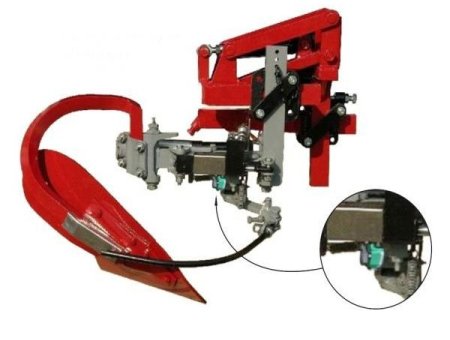
The decavaillonneuse consists of a plow body with specially shaped shares and mouldboards adapted to the work to be carried out.This plow body is positioned on a device that allows it to retract as the vines pass.
On the earliest plows, the device for releasing the plow body was a deformable parallelogram, operated by the feeler which acted as a lever. Nowadays, hydraulic devices have become the norm.
The hydraulic cylinder
The hydraulic cylinder is the most widely used solution for removing the dethatching element. The cylinder, controlled by a distributor operated by a feeler, deforms the parallelogram and retracts the plow body. The distributor can be controlled mechanically or electro-hydraulically. Mechanical control requires slightly more effort to trigger, but is more progressive. The hydraulic system can be powered by the tractor's oil or by an independent control unit. At Egretier, the power unit is a closed-circuit unit with a low reservoir capacity (a characteristic linked to the closed circuit), but also the use of a special hydraulic fluid (LHM), so beware of errors.The hydraulic torque booster
The hydraulic torque amplifier, used by Boisselet, is a system that combines a rotary distributor coupled to a hydraulic motor in a single unit. Actuating the feeler causes a control shaft to rotate, which in turn causes an output shaft to rotate at the same angle. The role of this device is to multiply the torque between the two shafts. It is a compact, simple and robust device.Different types of mouldboard
The different choices available concern the size, shape and slope of the mouldboards.- Effect of soil type
The clayier the soil, the higher the rear of the ploughshare will be in relation to the ground. - Effect of planting width
In narrow vineyards (planting widths of 0.70 m to 1.40 m), root-exposure work is carried out using a single ridging body; as the planting width increases, so too will the length of the mouldboard. The choice of ploughshare length for the de-stone plough, when used as the sole means of de-stone ploughing, will also follow this rule. - Impact of vine training system
The higher the vine trunk is trained, the more pronounced the upper curve of the ploughshare can be.
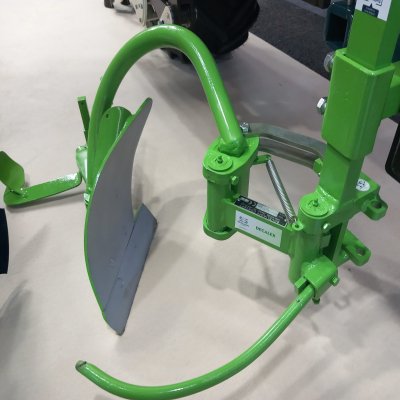 Décavailleunneuse mécanique
The choice of shape
This is often determined by the length of the mouldboards. They are generally cylindrical or semi-helical in shape. The shorter the mouldboard, the more cylindrical its shape. The longer the mouldboard, the more helical the shape will be to accompany the soil.
The choice of slope
The choice of plough mouldboard angle depends, in particular, on the available traction power and the characteristics of the soil. A steeper angle makes it easier to break up and turn the soil, but generally requires greater traction effort.Adjusting and using the mouldboard plow
Plow adjustment
The first thing to do, for inter-row tractors, is to adjust the overall width of the tractor's tyres. The tyres must fit within the furrows left by the previous ‘passes'. The strip of soil remaining beneath the vines must not be compacted, as the plough's skids must be guided along the furrows.
The stone remover must be perfectly centred, and the stabilisers must have very little play.
The ploughshares will work horizontally and must neither dig in nor drag.Generally speaking, the stone-removing plough bodies work a strip of soil 20 to 30 centimetres wide; the end of the mouldboard must extend a few centimetres (around 5 cm) beyond the centreline of the row. This measurement also depends on the shape of the ploughshares – in particular the sharpness of their points – and the shape of the vine stocks. The sensor must be positioned very close to the ground to minimise the risk of uprooting the vine stocks; this is all the more important if the vine stocks are twisted. The adjustment of the sensor is crucial as it not only triggers the mechanism but also allows the implement to resume work.The distance between the sensor and the tip of the plough's coulter determines the approach distance, whilst the distance between the end of the sensor and the tip of the coulter determines the distance for the plough to return to its working position. The sensor's adjustment directly affects the safety margin between the vine stock and the plough.
The stone remover must be perfectly centred, and the stabilisers must have very little play.
The ploughshares will work horizontally and must neither dig in nor drag.Generally speaking, the stone-removing plough bodies work a strip of soil 20 to 30 centimetres wide; the end of the mouldboard must extend a few centimetres (around 5 cm) beyond the centreline of the row. This measurement also depends on the shape of the ploughshares – in particular the sharpness of their points – and the shape of the vine stocks. The sensor must be positioned very close to the ground to minimise the risk of uprooting the vine stocks; this is all the more important if the vine stocks are twisted. The adjustment of the sensor is crucial as it not only triggers the mechanism but also allows the implement to resume work.The distance between the sensor and the tip of the plough's coulter determines the approach distance, whilst the distance between the end of the sensor and the tip of the coulter determines the distance for the plough to return to its working position. The sensor's adjustment directly affects the safety margin between the vine stock and the plough.
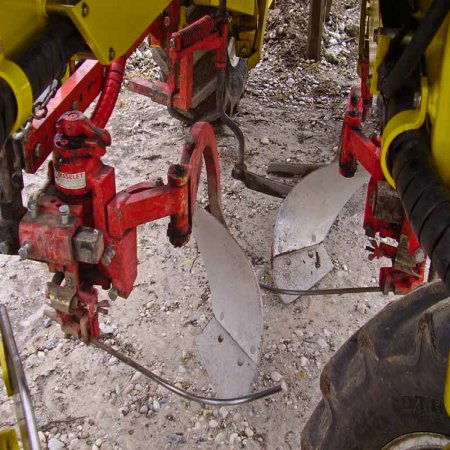
Hydraulic de-stalker mounted on a straddle tractor
Where to position your undervine plow?
Inter-row tractors
Generally speaking, dethatching ploughs are positioned on either side of a frame mounted on the tractor's 3-point system. However, decavaillonneuses can also be mounted at the rear of the vineyard plough frame. This arrangement is most common in vineyards with wide planting widths. For wide vines, there are also side-mounted units, mounted between the front and rear wheels of the tractor. This arrangement offers the advantage of good visibility of the work.Straddle tractors
For single rows, two ploughs are used, one behind the other, to work the space between the vines in the same row.Choice of share types
there are three main types of ploughshare- :
- Sharply rounded shares, which have to work with a parallelogram device and a sensor trigger.
- Skimmer shares, which allow parallelogram dethatching without a sensor. For safety reasons (protection of the stock), they are also mounted on de-tavellers with a sensor.
- Guard shares are used to maximise share detection when using parallelograms without a sensor.
Experiment
See the list of experimentsSee more