Drone
Drones are revolutionising viticulture by offering innovative solutions for monitoring and intervention. From mapping plots of land to spraying plant protection products (by dispensation only in France), these tools combine precision, efficiency and reduced inputs, with great potential for optimising farming practices.


Drones in viticulture
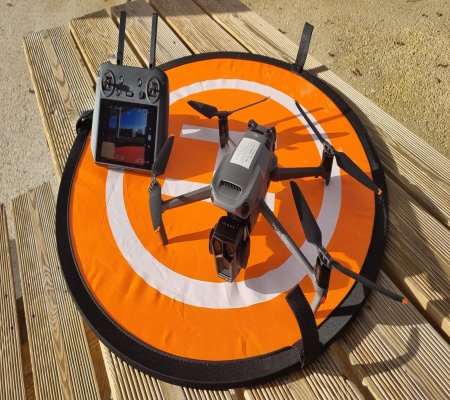
Imaging drone
Drones encompass a wide variety of devices and applications. In viticulture, there are two main categories: drones designed for data collection and drones capable of carrying a spraying system. The choice between them depends on the intended purpose, the area to be covered, the topography and the level of accuracy required.
- Imaging drones and on-board sensors: used to capture RGB, multispectral or thermal images in order to characterise intra-plot variability and support vineyard monitoring.
- Spraying drones: fitted with a tank, a pumping system and spraying components (hydraulic nozzles or atomisation systems, depending on the equipment). They enable spraying to be carried out at low altitude above the vegetation.
Drone spraying is a specific application technique, which should not be regarded as a simple adaptation of ground-based spraying. The airflow generated by the rotors, the low working height, the small volume of spray mixture generally carried on board, and the drone's flight path all affect the formation, transport and deposition of the droplets.
Technical specifications
Weight
Power consumption
Payload capacity
Range
Spray system
Maximum flow rate
Droplet sizes / adjustment range
Working width
Working speed
Spray height
Main uses
Image-capture drones
Equipped with RGB, multispectral or thermal cameras, survey drones enable the rapid assessment of a plot's heterogeneity. The images can be used to produce orthophotos, map vine vigour, identify anomalies or monitor changes in the vineyard. However, the quality of the results depends on the sensor, the acquisition conditions, the image overlap, the required resolution and the data processing. These tools complement, rather than replace, on-site observation.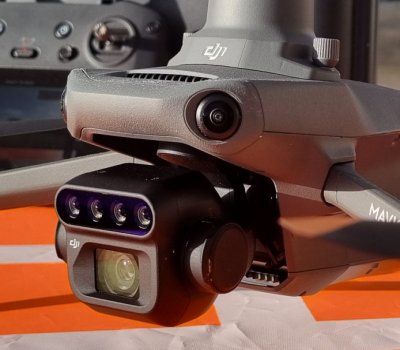
Image-capturing drone

Spraying drone
Spraying drones
These drones can serve as a complementary application method to ground-based sprayers, particularly where access to the plot is difficult. Their suitability must be assessed in light of the vineyard's layout and the desired quality of application.- Plots that are difficult to access or on steep slopes: treatment carried out without a tractor or sprayer entering the plot, which is of particular benefit in vineyards where mechanisation is not possible or difficult to achieve.
- Soil conservation and accessibility: no wheel tracks in the inter-row spaces, which prevents the soil compaction directly caused by the passage of machinery and can facilitate treatment where the soil's bearing capacity limits access for ground-based equipment.
- Speed of deployment: rapid preparation and deployment over small areas or targeted zones. However, the actual operational throughput depends on the tank capacity, battery life, distance to the refuelling point and recharging logistics.
Drone spraying is a low-volume application that requires precise adjustment. Key parameters include the volume per hectare, flow rate, droplet size, flight altitude, forward speed, trajectory relative to the rows, working width, as well as wind, temperature and humidity. These parameters interact with one another: a setting that works well in one configuration is not necessarily applicable to another.
General principle
The use of drones for the application of plant protection products is governed by specific regulations. The points below provide a brief overview; please refer to the dedicated regulatory section for detailed conditions, procedures and applicable legislation.Plots and crops concerned
Implementation programmes may, in particular, relate to:- agricultural plots with a gradient of 20 per cent or more, regardless of the crop;
- banana plantations;
- ground-grownrootstock vines;
- other types of plots or crops included on the regulatory list following demonstration, through trials, of clear advantages over ground-based applications.
Products concerned
Products sprayed by drone must fall within the categories set out in the regulations: biocontrol products included on the regulatory list, products authorised for use in organic farming, or low-risk products. They must also be approved for aerial spraying by drone in accordance with the Rural and Maritime Fisheries Code.Requirements relating to the drone and the operator
- maximum take-off mass of the drone not exceeding 200 kg;
- the drone must be fitted with a device representing the best available technology for reducing spray drift;
- use of a device recognised in accordance with the list published by the authorities; the type of nozzle alone is therefore not sufficient to establish that the system complies;
- possession of the Certiphyto certificate required of any person required to handle plant protection products or to remotely pilot the drone as part of the programme;
- the drone operator must hold the operating authorisation required by the applicable European regulations.
Protection of people and the environment
The programme must include measures to prevent treatment taking place near residential areas and areas open to the public, whilst complying with the safety distances specified in the authorisation. The conditions of use must also limit drift and comply with all the requirements relating to the product being used.Regulatory references
Rural and Maritime Fisheries Code, Article L. 253-8; Order of 29 May 2026 on the conditions for authorising drone application programmes; Decree No. 2026-422 of 29 May 2026 on programmes carried out on a trial basis; Memorandum DGAL/SAS/2026-315 of 3 June 2026 concerning devices constituting the best available technology for reducing drift.Trials in Gironde
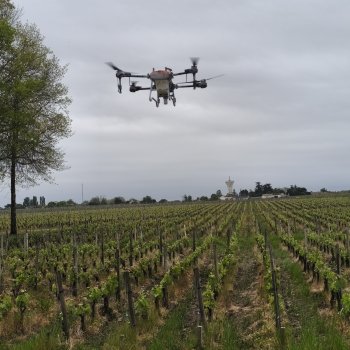
In 2026, the Gironde Chamber of Agriculture, in collaboration with the MSA, conducted a series of trials to assess the performance of drone spraying in viticulture.
This research focused in particular on the quality and uniformity of the spray deposit on vegetation, the penetration of the spray, and the influence of the main application parameters: volume per hectare, droplet size, flight altitude and speed.
The trials also enabled a comparison of different operational configurations and identified the main advantages and limitations of this technology under vineyard conditions.
The protocols, results and lessons learnt from these trials will be presented on this page in due course.
Drone trial in Gironde