
Intercep weedkiller
The principle of thermal weedkilling is to destroy the aerial part of plants by means of a thermal shock. The temperature of the leaf is raised to 70°C, causing the leaf proteins to coagulate and be destroyed. The action of thermal weeding can be likened to the application of a contact herbicide; only the parts affected and sufficiently heated are destroyed. Intervention at the seedling stage ensures good efficacy. The number of passes can be high, especially if the aim is to achieve very clean soil.
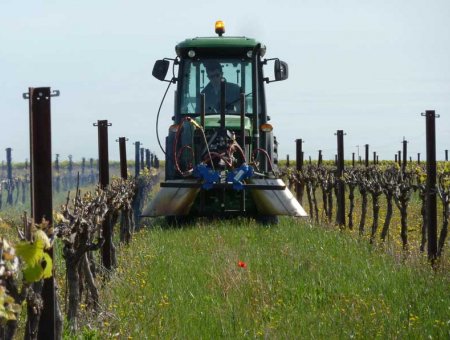
Open-flame thermal weed burner
Work objective
These are the oldest types of equipment; they use the combustion of a gas (often propane) to generate a flame that is directed at the weeds. Gas consumption varies depending on the performance of the burners. Their use is restricted to dry conditions where there is a real risk of fire. The forward speed is 2 to 3 km/h.Components
The chassis
One or more burners are mounted on the welded steel frame. This frame is also used to carry the gas cylinders.The burners
There are two types:- a coil that allows the gas to change from a liquid to a gaseous state. This is a complex burner that produces an unstable flame
- a torch-flame burner, where the flame produced is more stable. The burner is protected by a bell, the complexity of which varies depending on its design.
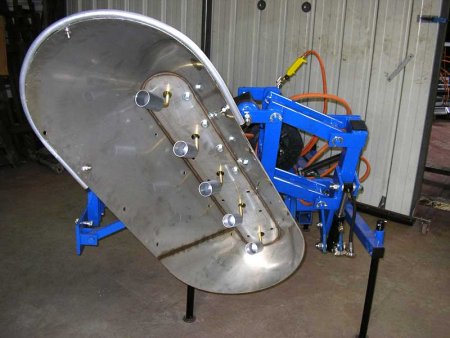
Thermal weed burners
The protective bell
The protective bell directs the heat flow towards the ground, thereby preventing any risk of the vine being scorched by rising heatr.The erasure system
Some set-ups are based on a parallelogram or ‘western'-style hinged axles. In the weed-control version, as the bell is mounted on a free-moving axle, the area in front of the vine is cleared by moving round it. This makes it possible to work as close as possible to the vine without the risk of snagging.Set-up and use
Settings
The settings for this implement depend on the growth of weeds. The forward speed must therefore be adjusted according to the density of the vegetation cover. It varies between 2.5 and 3 km/h.Use and fuel consumption
When using a thermal weeder, certain precautions must be taken toavoid the risk of fire (avoid using it in strong winds, during periods of drought, etc.).To achieve satisfactory results, it is best to treat weeds at the start of their growth cycle (at the seedling stage); the method is not effective on roots.
As a guide, gas consumption for one hectare of vineyard (2 x 1 m) ranges from 39 to 52 kg of gas ( 3 to 4 bottles of propane) per pass.
Water-powered weeder
Work objective
There is a range of high-pressure water weeders available. This equipment, powered either by the tractor's power take-off (PTO) or its hydraulic system, sprays water at a pressure of 15 bar. According to the manufacturer, the water sprayed onto the weeds acts on both the leaves and the roots.
There are also high-pressurehot water systems( 120°C).
There are also high-pressurehot water systems( 120°C).
Components
The high-pressure pump
It increases the pressure in the water delivery circuit to between 15 and 20 bar.The hot water production unit
In hot-water weeders, the water is usually heated using fuel oil to reach a temperature of between 120 and 135°C.The application system
This application system can be compared to a chemical weed control boom. It consists of a water supply hose, a nozzle that distributes the water over the plants, and retractable guards that protect against any water splashes or the risk of feet getting caught.Set-up and use
Settings
The work rate varies, depending mainly on the density of the vegetation cover. The forward speed and working pressure must be adjusted accordingly. The water flow rate is 18 L/min and the forward speed is 1.5 km/h..Usage
Spraying hot water causes the cells to burst and the proteins to denature (leading to the blackening of the herbaceous parts), thereby halting the activity of the above-ground parts.For information, water and fuel consumption are 3 m³ and 25 L/ha respectively, for weed control in vineyards with a row spacing of 2 metres.
Electric weeder
Work objective
The electric weeder consists of fixed and moving electrodes which treat the weeds beneath the ridges.
The principle involves passing a high-voltage current through the cells of the weeds. The electrical energy required is generated by the tractor's power take-off, which drives a generator.
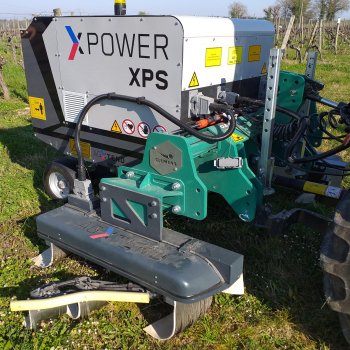
ZASSO XPS Electric Weeder
Components
The electricity generation unit
An electricity generator is driven by the tractor's power take-off, producing the energy required to operate the electrodes.The electrification system
The electrodes rub against the weeds growing beneath the ridge and release enough energy to destroy the plant's cells.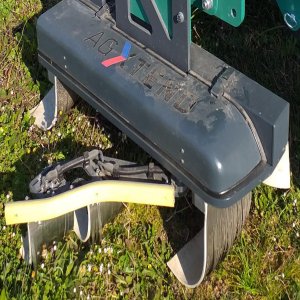
Electrodes