
Amphora
Amphorae, inherited from ancient winemaking traditions, are winning over more and more winemakers looking for authenticity and originality. Made mainly from terracotta (clay), stoneware or ceramic, these containers offer a unique alternative to traditional vats (stainless steel, wood, concrete). They give the wine a unique character and allow it to benefit from the micro-oxygenation of a barrel without the addition of wood, with the aim of respecting the notion of terroir and the expression of the fruit.
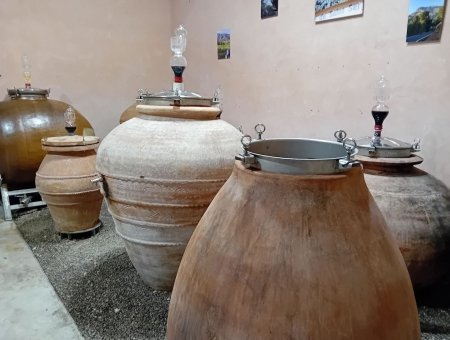
Amphorae
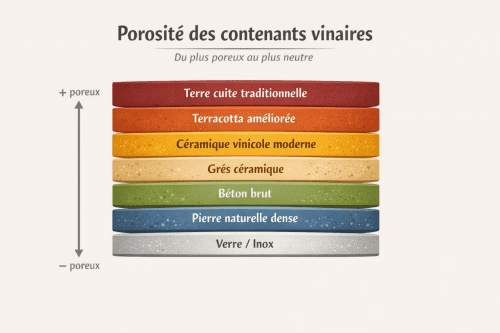
These containers are increasingly used in wineries for 'natural' vinification. They are made from a variety of materials:Terracotta (traditional clay)
- Effect : Natural micro-oxygenation
- Uses: Fermentation and ageing
- Characteristics: Variable porosity depending on cooking, so more or less exchange.
- This natural material often gives greater purity of fruit than wood.
Natural sandstone (sedimentary rock)
- Effect: Gentle micro-oxygenation, similar to or more controlled than an earthenware amphora.
- Uses: Fermentation and ageing (wines, beers and spirits).
- Characteristics: Harder, more stable and more homogeneous than terracotta.
Ceramics (a mixture of clay and grog)
- Effect: Controlled micro-oxygenation.
- Uses: Fermentation and ageing (wines, beers and spirits).
- Characteristics : Modern amphora with regulated porosity.
Natural stone (granite or similar)
- Effect: Better inertia and gentler ageing.
- Use: Fermentation and ageing (wines, beers and spirits)
The advantages of amphorae in winemaking
Gentle, natural micro-oxygenation
Thanks to the varying porosity of the materials used, terracotta (clay) amphoras allow micro-oxygenation comparable to that of wooden barrels, but without any additional aromatic contribution. This process naturally softens the tannins, while preserving the purity of the wine's aromas and flavours.Thermal inertia
Amphoras offer excellent thermal stability, thanks in particular to the ability of the different natural materials to absorb and release heat slowly. This characteristic is particularly valuable for controlling fermentation, especially in hot climates.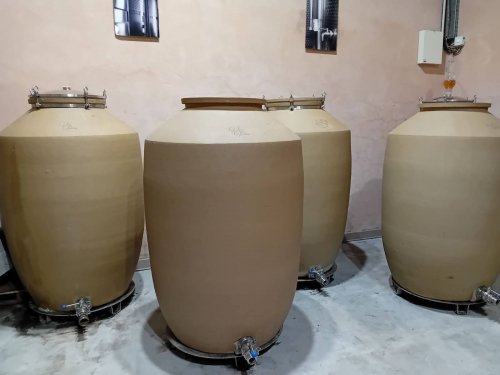
Photo credit : V&T Amphores | Vin et Terre
Aromatic neutrality
Unlike wood, amphoras do not add exogenous notes to the wine. They reveal the purest expression of the grape varieties and the terroir, while respecting the natural balance of the wine.Versatility of use
Amphoras can be used for both fermentation and ageing. They are suitable for a wide variety of wines: red, white and rosé, as well as sparkling and orange wines.However, the materials used (clay, sandstone, ceramic, etc.) will need to be adapted to suit the style of wine required and the management of micro-oxygenation.
A variety of shapes and finishes to suit every winery
Amphoras are available in a wide range of shapes and sizes to suit every need:- Ovoid amphorae: Ideal for allowing the lees to move naturally, thanks to their angular design.
- Cylindrical amphorae: More traditional, they optimise space in the cellar.
- Buried or semi-buried amphorae: Inspired by ancient practices, these amphorae provide even better thermal regulation.
The ecological benefits of amphorae
Amphoras, made from natural materials such as clay, are part of a sustainable approach that respects the environment. They require less energy to produce than stainless steel or concrete vats, and their longevity makes them a sustainable investment for winegrowers.Points to watch and maintenance
Although amphoras offer many advantages, they require special care:- Delicate cleaning: Porous surfaces must be carefully maintained to avoid contamination.
- Fragility : Although robust, amphoras are more vulnerable to impact than other types of vat.
- Investment costs: The price may be higher, particularly for large-capacity models or those made by hand.