
Inter-row tractor
The three-point linkage system, which complies with ISO 730 and 8759 standards, makes it easy to use tools specific to viticulture. In addition, their lightweight yet robust design offers excellent stability on the hilly and varied terrain of vineyards.
Finally, these tractors are generally equipped with advanced control and navigation devices for greater precision in vineyard tasks.

Introduction
Designed for vineyard work between the rows, the between-row tractor is characterised by its compact size, manoeuvrability and ability to work in confined spaces, whilst providing the power required for the various implements used in the vineyard.
Most conventional inter-row tractors fall within the T2 regulatory category for narrow-track tractors. This category covers wheeled tractors with a minimum track width of less than 1,150 mm, a kerb weight in running order of more than 600 kg and a ground clearance of 600 mm or less. Where the ratio of the tractor's centre of gravity height to the average of the minimum track widths of each axle is greater than 0.90, its maximum design speed is limited to 30 km/h.
Beyond these regulatory specifications, the choice of a row-spacing tractor depends above all on the work to be carried out and the conditions of use: row width, power and traction capacity, the tractor's weight and balance, turning circle, driver comfort and visibility, hydraulic flow rate, power available at the power take-off (PTO), and the ability to accommodate various vineyard implements.
The tractor required will therefore differ depending on whether it is intended primarily for soil cultivation, spraying, vineyard work, towing, transport or powering implements that require high power at the PTO.
Requirements for agricultural tractors

Inter-row tractor
- For pulling work
- For transport and handling work
- For PTO work
Hitch
The ISO 8759 standard concerns coupling systems positioned at the front of the tractor.The coupling system on an agricultural tractor is generally of the "three-point" type. It is made up of a number of components.
There are four categories of hitch in agriculture. In viticulture, the dimensions of hitching systems generally correspond to categories 1 or 2. They are based on the power developed by the tractor at the power take-off (see table below).

Lifting arm - Automatic hitch
| Categories | PTO power (Kw) |
|---|---|
| 1N | Up to 35 |
| 1 | Up to 48 |
| 2 | From 30 to 92 |
| 3N / 3 | From 60 to 185 |
| 4N / 4 | From 110 to 350 |

Dimensions of tractor coupling points
Dimensions for equipment coupling points :

Equipment attachment point dimensions
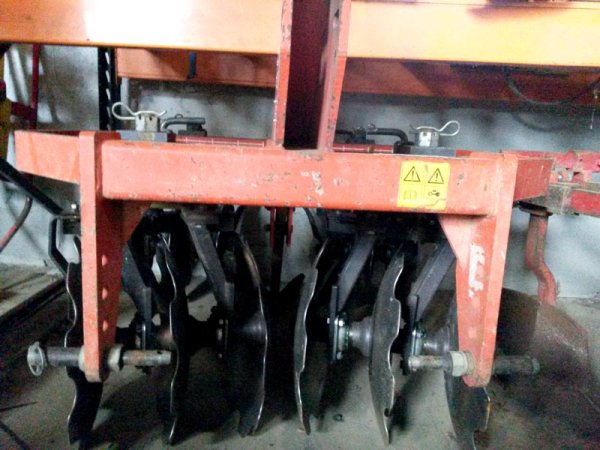
Ball hitch on serrated disc frame
New-generation tractors are equipped with a complete hitching system to facilitate the development of combined work.

Front 3-point linkage on an inter-row tractor

Rear hitch on an inter-row tractor

Trailer hitch on an inter-row tractor