
Chemical suckering machine
Chemical suckering works by spraying a contact weedkiller on the shoots. For optimum effectiveness, it should be applied when the shoots are still tender (not lignified) and, if possible, no longer than 20 cm. The amount of spray to be applied per hectare should be in excess of 200 litres.
Depending on the grape variety, two applications will be required during the season.
Depending on the grape variety, two applications will be required during the season.
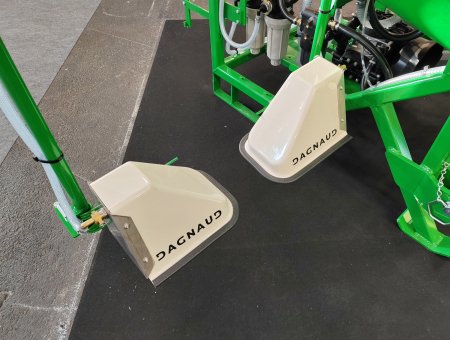
Components of the chemical suckering machine
The mast
Chemical de-budding involves spraying in a vertical plane. The equipment is often mounted on a gantry that spans the row, so as to remove the shoots from both sides of the vine simultaneously, while limiting the amount of spray. The mast provides the link between the gantry and the tractor. Fitted with hydraulic jacks, it can be adjusted for height, alignment with the row and, in some cases, tilt.The suckering head
Il se compose de 2 tronçons, chacun muni de 2 ou 4 jets orientables, afin d'assurer un mouillage correct des pampres. Certains constructeurs proposent même des tunnels équipés de 6 buses. Différents systèmes de sécurité permettent l'escamotage lors d'accrochages :- parallélogramme déformable au niveau des têtes d'épamprage
- ressort de rappel sur les montants du cadre
- ou simplement un axe reliant le cadre au mât assurant l'auto centrage de la tête d'épamprage
- Certains fabricants proposent d'équiper leurs tunnels d'épamprage de bacs/panneaux récupérateurs.
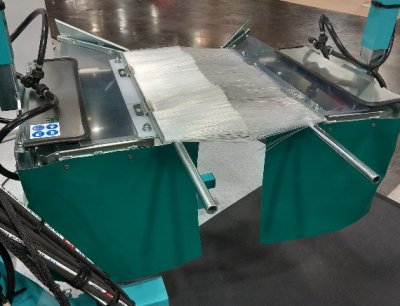
Tunnel épamprage chimique
Adjustment and use of the chemical suckering machine
Like all spraying equipment, there are a number of stages involved in setting up a chemical de-budding tunnel.
Determining the theoretical flow rate of the chemical suckering machine (D)
This is calculated using the following formula: D = (Q x L x V)/600
- The desired volume per hectare (Q) must be between 400 and 500 litres in order to properly wet the vine shoots while limiting run-off.
- The working width (W) corresponds to the height of the trunk on a flat surface.
- The forward speed (V) should be between 3 and 4 km/h. This is to ensure the right amount of work is done while avoiding rebound phenomena.
Note that the theoretical volume (D) calculated corresponds to one section (one side). To find out the total flow rate of the spraying boom, this value must be multiplied by 2 (since a spraying head comprises 2 sections).