
Harvest machinery
The grape harvester has become the norm in the vast majority of vineyards suitable for mechanisation. It enables grapes to be harvested quickly at the optimum stage and now offers numerous advantages for ensuring the quality of the harvest: easy adjustments, driver comfort, and on-board sorting and destemming. Its main limitation remains inaccessible plots and production under specific regulations that require whole-bunch harvesting.
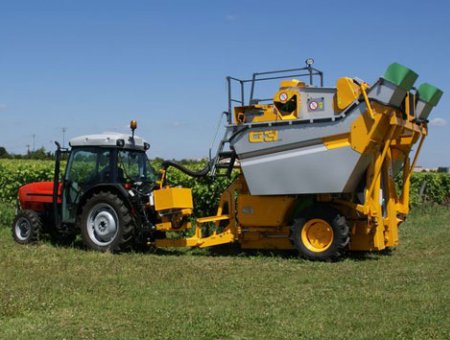
Since the 1970s, the mechanisation of the grape harvest has seen steady growth. Machines have brought about a significant transformation of vineyards to optimise their use: the vines have been trained into a goblet shape and training systems conducive to mechanisation have become the norm: Royat cordons and trellised Guyot.
Grape-harvesting machines have become the norm as they offer flexibility in the harvest schedule and considerably reduce the labour burden. Their ongoing development has been supported by regular technical improvements, both in terms of the harvesting heads and ease of use, enabling very satisfactory quality levels to be achieved, although differences remain compared with manual harvesting (harvesting involving a liquid phase and a solid phase, removal of stalks, and the need to sort green waste).
Modern grape harvesters consist of a chassis for propulsion and transport, and a harvesting head.
The quality of the harvest obtained using a grape-harvesting machine depends both on its settings and on how the vineyard has been prepared for its use. Shaking parameters, such as frequency, amplitude and pinch, must be adjusted according to the characteristics of the vines and the grapes.
Over 70 per cent of French vineyards are now mechanised, using machines developed by world-renowned French manufacturers.
Grape-harvesting machines have become the norm as they offer flexibility in the harvest schedule and considerably reduce the labour burden. Their ongoing development has been supported by regular technical improvements, both in terms of the harvesting heads and ease of use, enabling very satisfactory quality levels to be achieved, although differences remain compared with manual harvesting (harvesting involving a liquid phase and a solid phase, removal of stalks, and the need to sort green waste).
Modern grape harvesters consist of a chassis for propulsion and transport, and a harvesting head.
- The chassis can be either self-propelled or towed.
- The harvesting head, meanwhile, is fitted with lateral shaking systems that apply sufficient force to the vine to detach the berries from their stalks. The grapes are then collected by conveyor belts or flexible bucket elevators, which transport the berries to hoppers.
The quality of the harvest obtained using a grape-harvesting machine depends both on its settings and on how the vineyard has been prepared for its use. Shaking parameters, such as frequency, amplitude and pinch, must be adjusted according to the characteristics of the vines and the grapes.
Over 70 per cent of French vineyards are now mechanised, using machines developed by world-renowned French manufacturers.
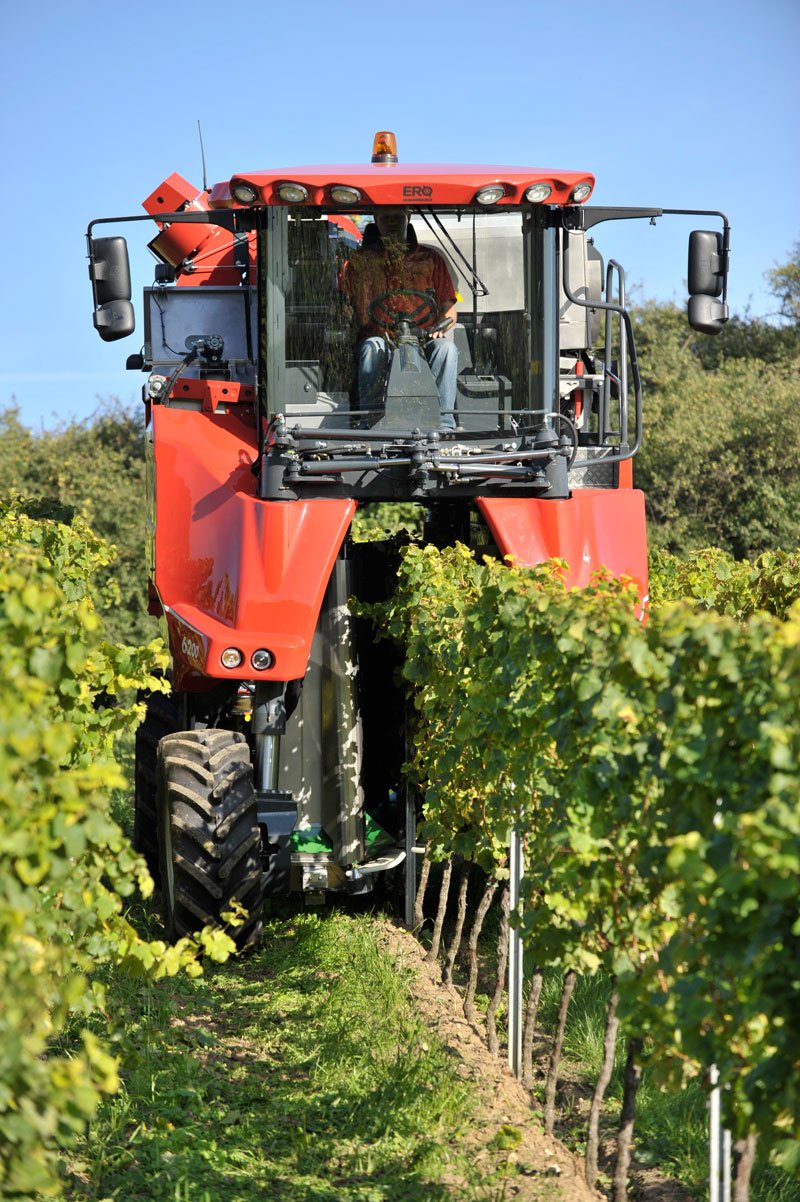
Harvesting machine in action
Experiment
See the list of experimentsSee more - Cleaning the mechanical harvest - 2015
- Mechanical harvesting, areas for improvement - 2014
- How to reduce diesel consumption by grape harvesting machines - 2012
- Influence of mechanical harvesting on the grape harvest - 2008
- General information on mechanical harvesting - 2007
- Test bench, mechanical harvesting - 2006