
Grape harvesting machine
Grape-harvesting machines, consisting of a motorised chassis and a harvesting head, mechanise the grape harvest by shaking the vines to dislodge the grapes.
These machines use shaking, collection and conveyor systems to transfer and clean the grapes, thereby minimising the need for manual labour. The versatility of the carriers, which allows the machine to be used for other tasks outside the harvest period, helps to offset the high costs of the equipment.
Careful management and precise adjustments are essential to ensure a high-quality harvest.
These machines use shaking, collection and conveyor systems to transfer and clean the grapes, thereby minimising the need for manual labour. The versatility of the carriers, which allows the machine to be used for other tasks outside the harvest period, helps to offset the high costs of the equipment.
Careful management and precise adjustments are essential to ensure a high-quality harvest.
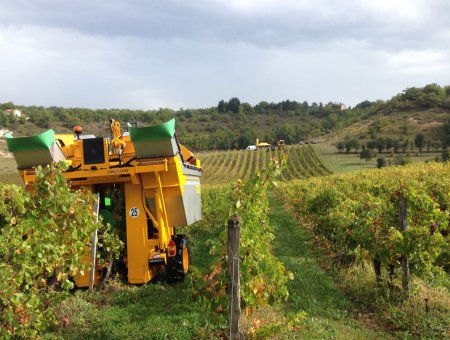
Technical overview of a grape-harvesting machine
A grape-harvesting machine consists of a chassis for propulsion and transport, and a harvesting head. The chassis is either self-propelled or towed. The harvesting head is the most important component. It comprises the shaking mechanism, the grape collection system, a system for transferring the grapes to the hoppers, the hoppers themselves and the cleaning mechanisms.Shaking
Grape-harvesting machines harvest the grapes by applying sufficient force to the vine to detach the berries from their stalks. The principle is therefore that of on-vine destemming, with the stalks being left on the vine. In practice, the situation is more nuanced, as the impact of the shaking also causes bunches, leaves and other parts to detach..
Lateral shaking has established itself as the most effective method. Two rows of shakers keep the foliage within the trellis plane. The shaking motion is transmitted via a crank-connecting rod system or by hydraulic cylinders acting on the shaft to which the shakers are attached. The shaking parameters are frequency, amplitude and pinch.
Each manufacturer has developed its own shaker design and operating method, whilst maintaining certain common features: the flared shape created by the alignment of the shakers at the front of the harvesting head allows for the gradual compression of the vegetation, its retention and the effective transmission of energy to dislodge the berries in the decompression zone. The shape or mounting of the shakers at both ends prevents excessive movement that could cause damage to the vegetation (whiplash effect).
Lateral shaking has established itself as the most effective method. Two rows of shakers keep the foliage within the trellis plane. The shaking motion is transmitted via a crank-connecting rod system or by hydraulic cylinders acting on the shaft to which the shakers are attached. The shaking parameters are frequency, amplitude and pinch.
Each manufacturer has developed its own shaker design and operating method, whilst maintaining certain common features: the flared shape created by the alignment of the shakers at the front of the harvesting head allows for the gradual compression of the vegetation, its retention and the effective transmission of energy to dislodge the berries in the decompression zone. The shape or mounting of the shakers at both ends prevents excessive movement that could cause damage to the vegetation (whiplash effect).
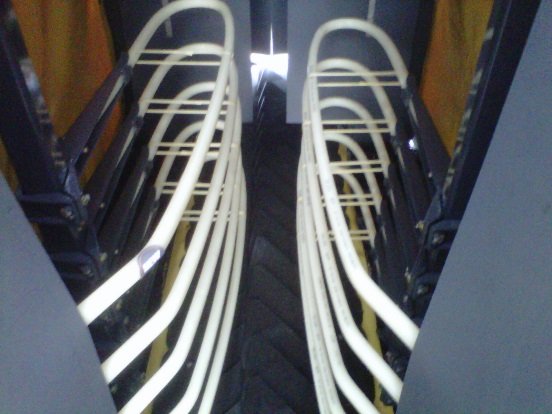
Shakers
Receipt of the grapes
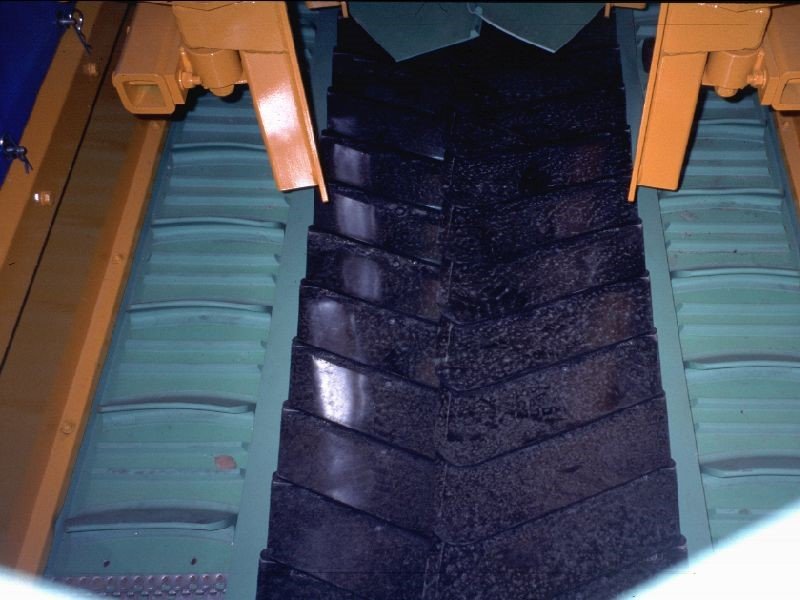
Receipt and transfer of the grape harvest via conveyor belts
According to the manufacturers, the grapes are fed into the machine and the harvest head is sealed either by a row of articulated scales that partially overlap, or by a chain of flexible buckets surrounding each vine. The scales are angled towards the transfer system (conveyor belts).
The chain of flexible buckets acts as both a collection and transfer mechanism, rotating within the harvesting head at a rate inversely proportional to the machine's forward movement. In this way, the buckets remain stationary relative to the vine.
Simple belt conveying
Conveyor belt transport requires a specific design of the cleats on the rotating belt to retain both the grapes and the juice. Spreading the harvest out on the conveyor belts allows for an initial cleaning by means of vacuum cleaners positioned below, before the leaves to be removed become too saturated with juice.Conveying using a bucket elevator
Before the grapes are tipped into the skips, the bucket elevator conveyor system spreads them out onto a rotating conveyor belt, which feeds the flow of grapes under a vacuum system designed to remove leaves as the grapes fall.Cleaning equipment
There are several types of cleaning equipment: vine shoot traps, vacuum cleaners, sorters and destemmer.They can all be fitted to a single harvesting head. The principle is simple: spread out the raw material to make it easier to suck up the leaves, drain it on a grid to separate the liquid and loose berries from the bunches and bunch fragments, and align the unwanted elements to facilitate their removal before they fall into the hoppers.
On-board destemmer units use either vibration or the cage-rotor principle. In addition to stalks, they remove more debris. The other components of the grape-harvesting machine are those that allow for easier or more difficult access to the controls and for the daily cleaning of the various parts: hatches, openings, ladders and platforms.
The versatility of the grape-harvesting machine and its chassis
Definition
A grape-harvesting machine is described as multi-purpose when, once its harvesting head has been removed, it can be fitted with one or more pieces of equipment that allow the chassis to be used outside the harvest season. The most common applications are spraying and pre-pruning.Multifunctionality involves fitting the chassis with at least two separate pieces of equipment that can work together.
Interest
Using a powerful machine over a longer period of the year than just the grape harvest helps to spread the cost of the significant investment it represents. Using it with a range of attachments also offers the potential for productivity gains and, for certain attachments, allows for better positioning as the machine straddles the row.Benefits
- Making the most of the frame
- Work more rows in a single pass, faster, to cover more area
- Carry heavier loads (operating range) or more equipment
- Position equipment more effectively along the row
Disadvantages
- Specialised equipment set-up
- Equipment is sometimes more expensive as it is more specialised
- Counterweight on the machine (same as Interligne)
- Heavy chassis: settlement
Manufacturers and versatility
The main manufacturers of grape-harvesting machinery in France are New Holland, Grégoire, Pellenc, Alma and Bobard. Their approaches to the versatility of their machines differ.- New Holland has developed specific partnerships with manufacturers to integrate their implements onto the carrier vehicle: these include Berthoud for spraying, Provitis for pruning, pre-pruning, leaf removal and GRV for fertiliser application. The speed of coupling with the spraying unit is a key selling point.
- Pellenc has built its Optimum range around versatility and multifunctionality, incorporating all vineyard operations, from pre-pruning to harvest, including soil preparation and green pruning. Two operations can be carried out simultaneously.
- Grégoire offers a range of sprayers fitted with drip-catch panels that can be fitted to the machine (ECOPROTECT range).
- Alma specialises in towed machines, with different levels of equipment for cleaning, sorting and destemming the grape harvest.
Impact of multi-purpose use on costs
- Increase in the number of operating hours for the chassis: reduction in the hourly cost of traction using the chassis. The cost is spread across several operations rather than being concentrated on the grape harvest.
- If the forward speed is higher, the time taken to complete the work is reduced.
- Significant savings if operations are combined (multifunctional).
- Fuel consumption increases due to the more powerful engine.
The role of towed machinery in manufacturers' product ranges
The range of self-propelled grape harvesters is complemented by towed grape harvesters, which are significantly less expensive and are designed for smaller vineyards. As well as being affordable, they are just as well equipped with technology (sorters, destemmer) as the self-propelled models. Choosing a towed grape harvester is another way of maximising versatility, as the farm's tractor is already used for other mechanised operations.Alma specialises in towed machines, offering different levels of equipment for cleaning, sorting and destemming the grapes.
Grégoire offers three towed machines in its range, from the simplest to the most fully equipped for sorting and destemming the grapes (EasyClean or Cleantech).
Pellenc offers a version that can be fitted with the on-board ‘Selectiv'Process2' sorting and destemming unit.
At New Holland, however, the trailed version is no longer available in the catalogue.
What are the most important factors in ensuring a high-quality harvest ?
The grape harvester works by shaking the vines to transfer the energy required to detach the berries from the stem. Ideally, mechanical harvesting involves the berries being stripped from the bunches whilst still on the vine. In practice, however, the fragility of the bunch stalk at the time of harvest, combined with the mechanical impact of the harvesting head on the entire vine and the trellis system , results in a mixture of whole bunches and fragments of bunches, detached berries (whole or burst), juice, and a number of undesirable elements such as leaves, petioles, pieces of vine shoots or other debris from the trellis.The harvest is more or less liquid in consistency, and this affects the interactions between the must, the skins, oxygen in the air and the various elements that may be present. Thus, when harvesting white grapes, it is particularly important to do everything possible to limit oxidation: protection using dry ice or the addition of SO₂.To avoid the potential negative impacts of mechanical harvesting, the first step is to focus on the vineyard and the trellising system. It is the vineyard that must be adapted to mechanisation, not the other way round. Particular attention must be paid to the posts, which will be subjected to significant stress and must be able to transmit the energy generated by shaking. A vertical growth habit, supported by lifting wires, is more conducive to the passage of the machine than a drooping habit, where the shoots are more prone to breakage. Finally, it must be borne in mind that the ties and clips for the lifting wires will also be subject to coming loose to a greater or lesser extent.The health of the vineyard is particularly important, as the machine does not sort what it knocks down, and the laccase activity associated with grey rot, for example, is particularly harmful.Finally, it is through the machine itself and its operation that the parameters necessary for a high-quality harvest will be fine-tuned, taking into account the characteristics of the vines and the grapes.
Some useful definitions for adjusting the grape-harvesting machine
- The gap: the thickness of vegetation that cannot be compressed along the row. This is the minimum distance between two shakers on either side of the harvesting head. It must be sufficient to hold the vine securely during shaking, not too tight to avoid pulling on the shoots, and not too loose, otherwise the vine will be beaten rather than shaken. The width of the foliage canopy and its density are the criteria that will determine this setting.
- Shaking frequency: the number of shaking cycles per minute. Together with the forward speed, this is the parameter that determines the number of pulses required for fruit detachment per metre travelled.
- Amplitude: this parameter defines the length of the stroke of a moving shaker. Amplitude has a very significant impact on the energy transmitted for the detachment process.
Set up the machine in just a few steps
- Adjust the number and position of the shakers to suit the fruiting zone: there is no point in covering a wider area, as this will increase the number of leaves that are dislodged.
- Set the forward speed moderately: around 3 km/h. Speed is detrimental to harvest quality as it increases mechanical impact.
- The shaking frequency should be adjusted in increments of 10 strokes per minute, depending on how difficult it is to dislodge the berries and also on the forward speed, to ensure a sufficient number of shaking cycles per metre.
- Amplitude: apart from extreme cases, it is best not to adjust this setting too much as it has a very significant impact.
- Conveyor belt speed for effective spreading and cleaning of the grapes.
- Power of the vacuum units responsible for removing leaves and other debris: a balance must be struck between high power and the risk of sucking up juice, by monitoring the flow at the exhaust nozzles.
- Steering: a harvester head is a heavy piece of equipment with a certain amount of inertia. Some deviation is permitted, but staying aligned with the row remains the best way to minimise impact on the vegetation.
- All these parameters are interdependent! For example, if the detachment conditions are very good, a forward speed that is too low can result in shaking that is proportionally too aggressive and in grape losses in front of the harvesting head. Conversely, with too high a speed and less favourable detachment conditions, there may be losses on the vine due to insufficient shaking relative to the speed, and losses on the ground as detached berries may fall behind the harvester head once the vegetation has been loosened.It should be noted that, due to differences in the design of the harvesting heads, settings – particularly those relating to shaking frequency – cannot be directly applied from one make to another.
What are the differences between manual and mechanical harvesting in terms of the quality of the finished product ?
Harvesting is just one stage in the production of quality wines. The key to obtaining healthy, ripe grapes lies in the vineyard throughout the growing season, and winemaking is essential to unlocking their full potential. Between these two stages, the harvest is a key step; mastering it ensures that the grapes' potential is not compromised. What are the main differences, and where does the distinction between manual and mechanical harvesting lie?- A machine does not allow for the sorting of grapes in the vineyard, particularly where botrytis is present.
- Machines produce juice in varying proportions depending on the grape variety and how easily the grapes detach from the vine (ranging from 1 to 35 per cent), which increases the risk of oxidation.
- Machines do not retain the stalks, whereas in some cases winemakers value them (for their draining effect in the press, or for the fresh notes they impart to the wines).
- The machine allows certain undesirable elements (animals, leaves, vine shoots, petioles) to fall into the hoppers; these must be removed to prevent the transfer of undesirable flavours.
These drawbacks are offset by the ability of the on-board equipment to sort out a very large proportion of these elements. Oxidation of the must can be prevented by applying protection very early on in the hoppers (sulphiting or dry ice).
Mechanical harvesting also allows, thanks to its speed, for grapes to be left until they reach perfect ripeness and for homogeneous batches to be harvested quickly, or for a rapid response to be made before weather conditions deteriorate, thereby having a direct impact on preserving the quality of the grapes.
Numerous trials carried out in various wine-growing regions have shown that, in most cases, mechanical harvesting produces wines that are entirely comparable to those made from hand-harvested grapes. The human factor remains crucial to ensuring this quality, as incorrect settings can also compromise the result.
There are, however, specific cases where manual harvesting is preferred: carbonic maceration for young wines, whole bunches required by production specifications, or very strict quality control requirements for very high-end wines.
Safety
Working around a grape-harvesting machine involves certain risks. People working near the machine are at risk of being crushed (due to poor visibility) or struck by flying debris (caused by the extraction fans).A safety perimeter must be established from the start of the harvest to minimise these risks (10 m around the machine). Anyone working on the machine must ensure that the engine and all moving parts, such as the extractors, have come to a complete stop before carrying out any work on the harvesting head. Finally, no one must be on the machine whilst it is harvesting. Access points at height on the harvesting head are reserved for cleaning or dismantling operations.
Storage
The grape harvest has just finished. If you want to ensure your grape-harvesting machine retains its full potential and avoid any problems when you start it up again, there are a few precautions you should take:
- Thorough cleaning is essential. This should be carried out using a strong flow of water at low pressure; high-pressure washers must not be used, as pressurised water can penetrate the bearings and electrical connections.
- The machine should be thoroughly lubricated immediately after cleaning, as the bearings are not rust-proof and the cleaning water causes them to rust very quickly. Do not forget to generously lubricate the legs with a high-quality grease (such as graphite-based grease) to prevent them from seizing up.
- The machine must be filled with diesel before being put into storage for the winter to prevent condensation in the tank.
- The battery charge should be checked approximately once a month.
- It is advisable to run the machine once a month, operating all the hydraulic systems to dislodge any drops of water resulting from condensation in the tanks, or sometimes from water entering the system during cleaning. In this regard, it should be noted that if the hydraulic oil appears cloudy, this is often a sign that it has been contaminated by water; it is advisable to change it.
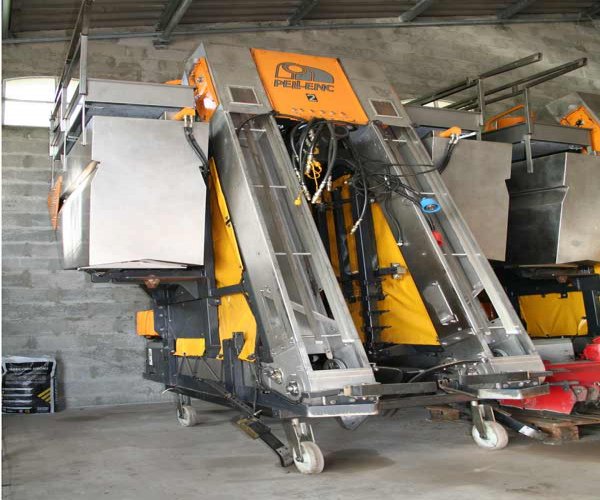
Pellenc harvesting head in storage
Conveyor belts
The conveyor belts will be dismantled and stored flat or rolled up on wide-core reels in a dry, light-proof room.The waterwheels
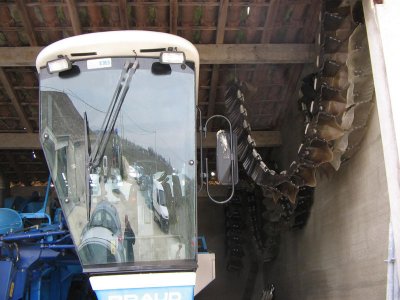
Bucket hoists removed from the grape-harvesting machine
The bucket wheels will be dismantled from the machine, stored and suspended by their links from the beams of a hangar, for example (storing them in piles causes them to become misshapen and results in a loss of watertightness in the rear riser of the machine).Whilst the bucket elevators are being removed, the rails should be oiled to prevent them from rusting (as rust causes rapid wear of the runners when the machine is restarted).
On ALMA machines, it is advisable to lubricate the conveyor chain with food-grade grease.
The Shakers
Every year, we still come across a considerable number of fruit-shakers that need to be straightened; this is particularly true of older GREGOIRE shakers, but also applies to PELLENC models. The material the shakers are made of tends to revert to its original (straight) shape. If they are left fitted without being secured using Rilsan cable ties (be careful, as these may come loose), wide packing tape, or even wire, they will slowly return to their original shape, making re-shaping necessary. PELLENC recommends fitting a brace to secure the shakers in place every evening after work.On New Holland–BRAUD machines, monitor the wear level of the shakers to prevent them from breaking, which could cause damage (see manual).
Revision
Don't leave it until the last minute!All too often, people only start worrying about getting their machine serviced just before they go on holiday – by then it's too late. It's also the holiday period for dealers, and workshops are overwhelmed. Don't wait until the last minute – take advantage of ‘off-season' prices to have your machinery serviced. If your conveyor belts are damaged, have them repaired.
The intensive use of grape-harvesting machinery generates maintenance costs that aren't incurred during normal harvest operations, so it may be worth considering reconditioning an engine used intensively after around 6,000 hours, or, on certain machines, replacing the leg bushings after 3,000 hours of use. On machines with less robust chassis, some users have observed structural fatigue caused by intensive use at working speeds higher than those typically used during the harvest.
Hygiene
Cleaning the machine every day is essential.Sugars and other plant residues provide breeding grounds for micro-organisms that can compromise the quality of the harvest. Whilst full disinfection isn't necessary, the bulk of the residue must be removed. To do this, start by removing visible clumps by hand or with a brush; this saves time and reduces the amount of water that will be used later on. The water flow should be high and the pressure low to avoid damaging the bearings. It takes between 2 and 3 m³ of water to clean a grape-harvesting machine thoroughly. The systems built into the harvesting heads do provide effective rinsing, but they are not sufficient on their own.
It is important to recognise that this is a significant source of pollution, even though it consists solely of organic matter (sugars, plant matter). This pollution is all the more significant if it is concentrated in a specific location, as is the case with communal cleaning areas. These areas have the advantage of being well designed for optimal cleaning, and sharing the facilities offers financial benefits. The need to take the environment into account must prompt us to think more carefully about our practices in this area. For example, we could consider hybrid solutions combining an initial cleaning of the machine on the field with a final wash at a washing area. In this way, some of the effluent is spread on the field, thereby reducing the volume at the communal washing area. This requires a mobile clean-water tank to accompany the harvesting operation.
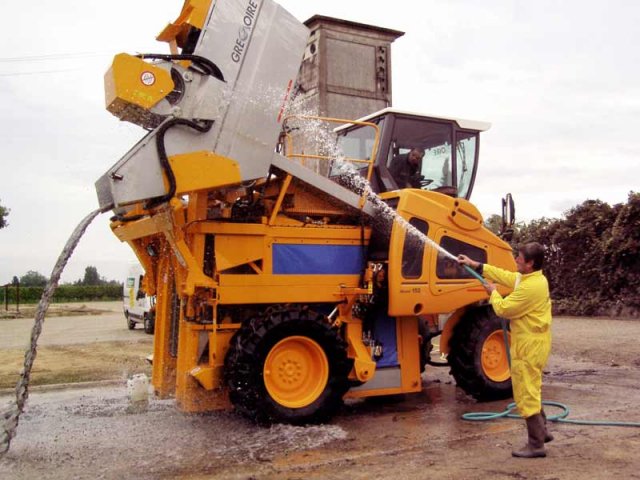
Cleaning a grape harvesting machine with a water jet
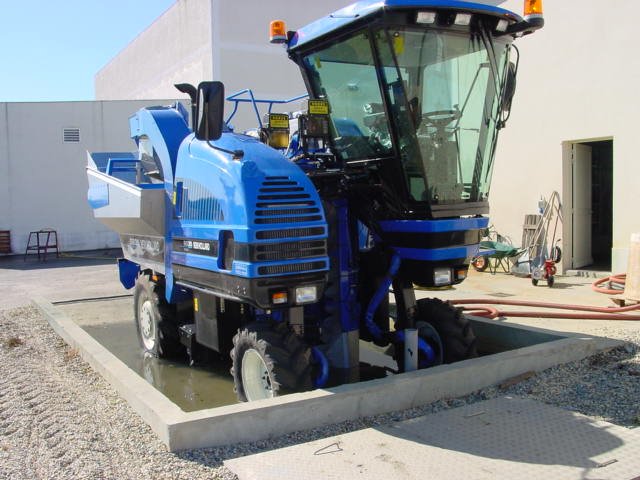 Harvesting machine on a washing area
 Experiment
See the list of experimentsSee more